





















 English
  Français
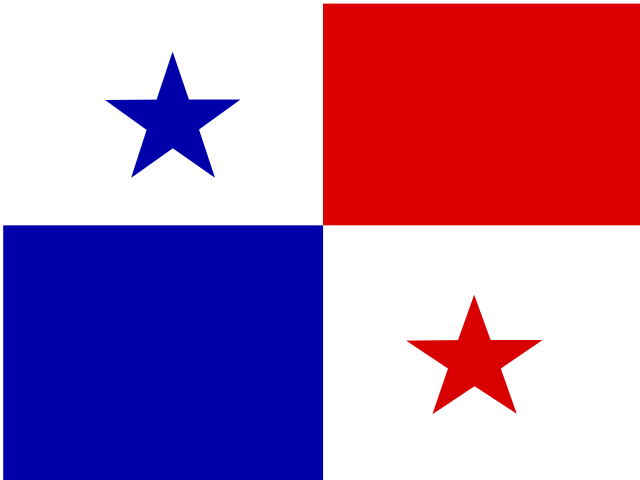
 Bevor Sie nach Panama ziehen, ist die entscheidende Frage nicht „ist die Versorgung gut“ — sondern „kann ich sie mit einem befristeten Visum tatsächlich nutzen, und was passiert im Notfall?“. Hier steht, wie das System für einen Nomaden funktioniert und wo die private Versicherung ins Bild passt.
Auf einen Blick
- System
- Gemischt öffentlich/privat
- Öffentlicher Zugang (Nomaden)
- Nur mit Sozialversicherungsbeiträgen
- Notrufnummer
- 911
- Privater Hausarztbesuch
- ~€37
- Versorgung auf Englisch
- Englische Versorgung in Großstädten
So funktioniert das System
Panama runs a segmented public health system with a large private sector. The public side has two arms: the Caja de Seguro Social (CSS), a Bismarck-style social-insurance fund financed by payroll contributions that covers the formally employed and their dependents (the larger share of the insured population), and the Ministry of Health (MINSA), which delivers tax-funded, low-cost services to everyone else, including the uninsured and foreigners. The two run parallel facility networks; PAHO notes weak coordination between them and a 2019 decree (Executive Decree No. 290 of 9 July 2019) aimed at coordinating their services. Out-of-pocket spending is high, accounting for about 37% of total health expenditure (2021), reflecting heavy reliance on private clinics and hospitals, which are concentrated in Panama City.
Panama has a well-developed private sector centered on Panama City, used by most expats and nomads. Private hospitals offer modern facilities, short waits and English-speaking staff, with many physicians trained in the US or Europe. Two Panama City hospitals have held Joint Commission International (JCI) accreditation since 2011 — Hospital Punta Pacifica (Pacifica Salud), the only Central American hospital affiliated with Johns Hopkins Medicine International, and Hospital San Fernando. Private GP consultations typically run about USD 20-60 in the cities (less in rural areas), and a private ER visit can run higher; routine care is affordable by US/European standards, but major surgery, ICU or complex care can approach US prices, so robust international or local private insurance is strongly advised. Most private hospitals require payment in advance or proof of insurance.
PAHO (Health in the Americas) classifies Panama's system as segmented between MINSA and the social-security fund CSS, with public health spending around 5.4% of GDP (5.38% in 2021) and out-of-pocket spending about 37% of total health expenditure in 2021 — a high share that signals significant private financing and coverage gaps in the public system. Quality is uneven: Panama City hosts JCI-accredited, internationally affiliated private hospitals, while rural public facilities are more basic and waits in the public system can be long. The private GP cost is a mid-range estimate aggregated from non-official expat/insurance sources and varies widely by provider.
Gut zu wissen
- Private hospitals in Panama City are high quality, with two JCI-accredited facilities (Hospital Punta Pacifica, affiliated with Johns Hopkins Medicine International, and Hospital San Fernando) and many US/Europe-trained, English-speaking doctors.
- MINSA public clinics and ERs are open to everyone, including foreigners and tourists, at very low cost — a basic public GP visit can be roughly USD 9-11 and a public ER visit around USD 50-100.
- Private care is affordable for routine needs by US/European standards: a private GP consultation is typically about USD 20-60 in the cities.
- Emergency response runs through SUME 911, the national pre-hospital ambulance system, reachable on 911.
Worauf Sie achten sollten
- A temporary resident or nomad cannot join CSS (the contributory social-insurance fund) — that requires being a formally employed permanent resident who pays into it — so plan to rely on out-of-pocket payment, MINSA public clinics, or private health insurance.
- Quality and English-speaking care are concentrated in Panama City; rural public facilities are more basic and may have longer waits and limited English.
- Major surgery, ICU or complex private care can approach US prices, and private hospitals typically demand payment up front or proof of insurance — comprehensive international/private cover is strongly advised.
- Public ambulance coverage via SUME 911 can be slow given traffic and road conditions outside the capital; private ambulance services exist as an alternative.
🩺 Versicherung, die Sie brauchen
Da befristet Ansässige sich kaum auf das öffentliche System stützen können und das Remote Worker Visa eine Deckung verlangt, ist die private Krankenversicherung Teil des Umzugs — kein nachträglicher Gedanke. Wir listen die Tarife, die die Anforderung von Panama plausibel erfüllen, sortiert nach Passung.
Qualifizierende Tarife für Panama ansehen →Gesundheitsversorgung in Panama: FAQ
Gesundheitsversorgung in Panama: FAQ
Kann ich als digitaler Nomade das öffentliche Gesundheitswesen in Panama nutzen?
Kurz gesagt — das öffentliche System steht nur offen, wenn Sie in das Sozialversicherungs-/Gesundheitssystem einzahlen — die meisten Nomaden nutzen stattdessen eine private Deckung. Panama has a well-developed private sector centered on Panama City, used by most expats and nomads. Private hospitals offer modern facilities, short waits and English-speaking staff, with many physicians trained in the US or Europe. Two Panama City hospitals have held Joint Commission International (JCI) accreditation since 2011 — Hospital Punta Pacifica (Pacifica Salud), the only Central American hospital affiliated with Johns Hopkins Medicine International, and Hospital San Fernando. Private GP consultations typically run about USD 20-60 in the cities (less in rural areas), and a private ER visit can run higher; routine care is affordable by US/European standards, but major surgery, ICU or complex care can approach US prices, so robust international or local private insurance is strongly advised. Most private hospitals require payment in advance or proof of insurance.
Wie lautet die Notrufnummer in Panama?
911. Rufen Sie sie bei lebensbedrohlichen Notfällen an; Notaufnahmen behandeln Sie unabhängig von der Versicherung, aber Ihnen kann nachträglich eine Rechnung gestellt werden, wenn Sie nicht versichert sind.
Brauche ich eine private Krankenversicherung in Panama?
Ja — über die Vernunft hinaus verlangt das Remote Worker Visa sie (erforderlich (ausdrücklich)). Siehe die qualifizierenden Tarife für Panama.
Quellen
- International organisation Panama — Country Profile, Health in the Americas (PAHO/WHO) (opens in a new tab) accessed 2026-06-15
- Government SUME 911 — Sistema Único de Manejo de Emergencias Prehospitalarias (official site) (opens in a new tab) accessed 2026-06-15
- Government SUME 911 utilizará nueva plataforma tecnológica — Ministerio de Gobierno de Panamá (opens in a new tab) accessed 2026-06-15
- Media Panama Healthcare System: Pros, Cons and Access for Foreigners (opens in a new tab) accessed 2026-06-15
- Media Joint Commission International Accredits Johns Hopkins-Managed Hospital Punta Pacifica in Panama (opens in a new tab) accessed 2026-06-15
- Media Pacífica Salud Hospital Punta Pacífica — Johns Hopkins Medicine International (opens in a new tab) accessed 2026-06-15
- Aggregated index Health care in Panama — Wikipedia (opens in a new tab) accessed 2026-06-15