





















 English
  Français
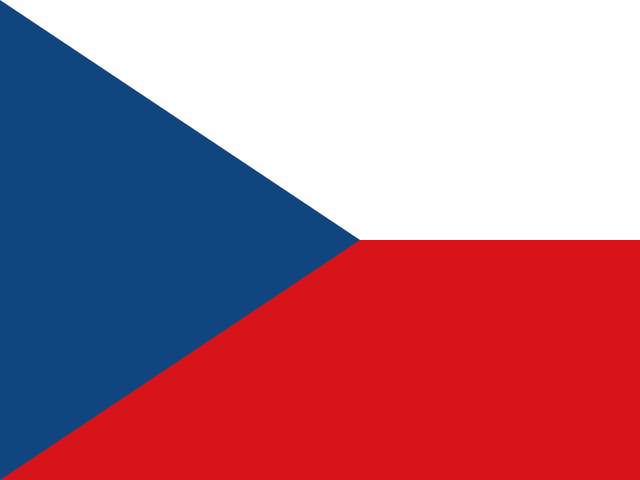
Czech Republic's "Zivno" Visa Has No Monthly Income Figure
If you are comparing freelance and remote-work routes across the EU, the Czech Republic’s main one works differently from most. Its route is the Long-term Visa for the Purpose of Doing Business, known colloquially as the “Zivno” after the trade licence (živnostenské oprávnění) it is built around. The practical thing to understand before you start: there is no monthly income threshold to meet. Instead, you show a fixed amount of savings.
We rate this guide medium-confidence, so treat the figures below as a starting point and confirm the current requirement with the Czech embassy before you apply.
Savings, not a monthly salary
Many nomad and freelance visas ask you to prove a recurring monthly income. The Zivno route does not. There is no official monthly figure — neither in local currency nor in euros — that you have to hit.
What the route asks for instead is proof of funds: a lump sum of 156,500 CZK (about EUR 6,260 at an exchange rate of roughly 1 EUR to 25 CZK). The legal basis is described as 50 times the “existential minimum”, and it is explicitly a one-time proof of funds rather than monthly income. So the test is whether you can show that amount, not whether you earn a set salary each month.
That distinction matters in practice. If your freelance income is irregular, you are not measured against a monthly bar; you are asked to demonstrate a savings cushion at the point of application.
You run a Czech trade — and the tax follows
The route is named after the trade licence for a reason. Holders run a self-employed trade in the Czech Republic (OSVČ) under a Czech trade licence, and local clients are allowed. You are taxed as a standard Czech resident. You may opt into an optional flat-rate scheme (paušální daň) that bundles income tax with contributions; otherwise the standard 15% / 23% rates apply. For more on how this works, see our Czech Republic tax guide.
Becoming a Czech tax resident is tied to spending 183 days in the country, or having a permanent home there. Because the visa is built around running a local trade rather than working remotely for a foreign employer, plan for that residency threshold from the outset rather than treating tax as an afterthought.
Insurance: required, but no stated minimum
Insurance is explicitly required for the full visa period. One caveat is worth flagging: no specific minimum coverage sum is stated on the Czech ministry pages. The requirement takes the shape of travel medical insurance for the first 90 days plus comprehensive cover for the rest, or comprehensive cover for the entire stay. Czech consulates often expect a locally recognised insurer, so a generic Schengen travel policy may not be accepted on its own — check what your specific consulate will recognise.
The practical timeline
The visa is applied for in person at an embassy. The consular fee is 5,000 CZK (about EUR 200), and processing runs roughly 13 to 17 weeks. The visa is valid for up to one year; to stay longer you switch to a Long-term Residence Permit (valid for up to two years, renewable), which opens a path to permanent residence and, via PR, citizenship.
The single takeaway: budget around the 156,500 CZK savings proof rather than a monthly income figure, because on this route the income figure does not exist.
Programs in this post
Responsible editor at living-abroad.org. Reviews every figure against its official source before publication — every claim sourced, every figure dated.
Keep reading
Related articles

Argentina's Nomad Visa and the Tax-Residency Question
Argentina's digital nomad residence is transitory and doesn't by itself create tax residency; the precise trigger for holders is unspecified — verify with AFIP.

Brazil's Nomad Visa Income Bar Is Set in US Dollars
Brazil's VITEM XIV asks for USD 1,500/month or USD 18,000 in funds from foreign sources — a dollar figure, not a Brazilian-real one. Here's what that means.
Colombia's Nomad Visa Lasts 24 Months, Tax Residency 183 Days
Colombia's digital nomad visa runs up to 24 months, but staying past 183 days in any 365-day window triggers worldwide tax residency with DIAN.